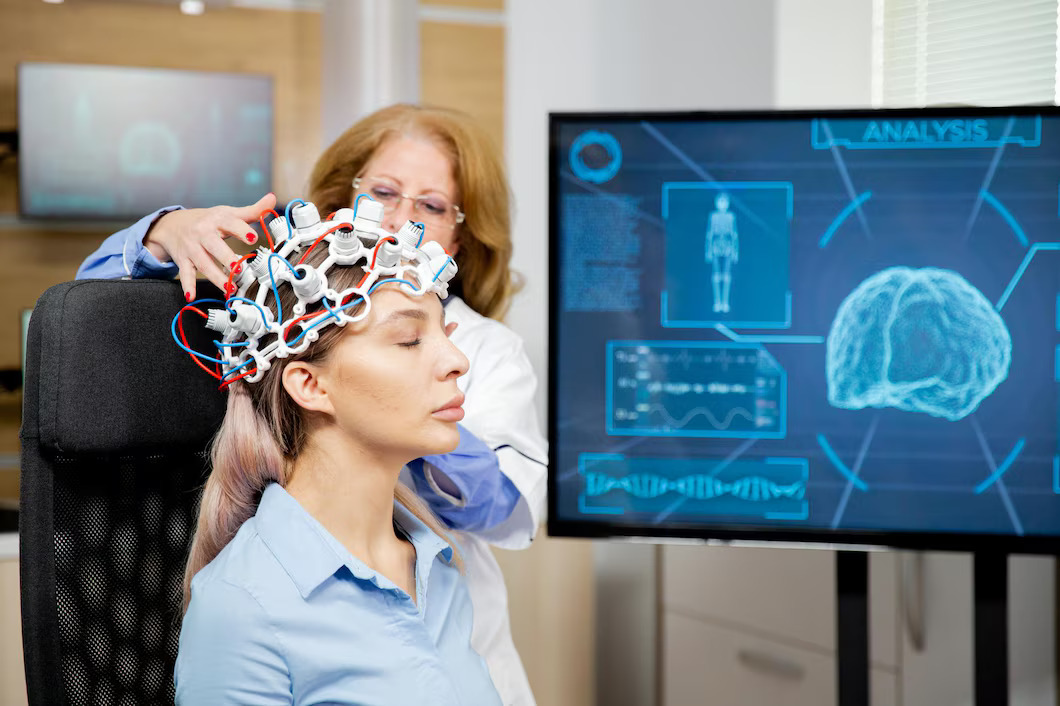
For most of human history, the relationship between our brain and our belly has been a “one-way street” of cravings and confusion. We feel a sudden urge for salt, a desperate need for sugar, or a vague sense of “emptiness,” and we respond by eating whatever is closest. But in the age of ultra-processed foods, our internal compass is broken. Our brain’s reward centers have been “hacked” by chemists to crave things we don’t need. As we move toward 2030, the bridge is being rebuilt. Brain-Computer Interfaces (BCI) are emerging as the ultimate tool for nutritional biofeedback. By reading the electrical and chemical signals of the brain in real-time, these devices allow us to see through the “noise” of cravings and identify the “truth” of our metabolic needs.
The Hypothalamus: The Body’s Master Dashboard
The hypothalamus is a small region at the base of the brain that acts as the control center for hunger, thirst, and energy balance. It is constantly receiving signals from your gut (Ghrelin and Leptin) and your blood (Glucose and Insulin).
The BCI Translation
A Brain-Computer Interface—whether a non-invasive wearable or a high-precision neural implant—monitors the firing patterns of these metabolic neurons.
- Neuro-Nutrigenomics: It combines your DNA data (like your DRD2 dopamine receptor status) with real-time neural activity.
- Hunger vs. Appetite: The BCI can distinguish between “Homeostatic Hunger” (your body actually needs fuel) and “Hedonic Appetite” (your brain just wants a dopamine hit).
- Nutrient Specificity: It can detect the unique neural signatures of “Micro-Hunger”—the specific brain state associated with a lack of Magnesium, Iron, or Omega-3s.
Brain-Computer Interfaces
The diet industry’s focus on “willpower” is a neurobiological insult; the only way to solve the obesity epidemic is through direct neural biofeedback.
This is true because willpower is a finite resource processed in the prefrontal cortex, which is easily overwhelmed by the ancient, powerful signals of the reward system. When your brain is “shouting” for sugar due to a stress-induced cortisol spike, “thinking” your way out of it is a losing battle. A BCI provides a “Third-Person Perspective” on your own cravings. It shows you the data: “Your brain is not hungry; it is experiencing a 40% drop in GABA due to stress.” This objective nutritional biofeedback shifts the decision from a struggle of “will” to a simple matter of “data.”
Consider a user with a genetic predisposition to low dopamine (ANKK1 variant). They are prone to “Binge Eating Disorder” because their brain never feels “rewarded” by normal food. Traditionally, they would cycle through diets and guilt. With a BCI wearable, the device detects the “Dopamine Dip” before the craving even starts. It sends a haptic vibration to their wrist and a notification to their personalized nutrition app, suggesting a high-protein “Tyrosine” snack to naturally boost dopamine levels. The user “pre-empts” the binge. This is the future of neuro-nutritional feedback.
Therefore, the role of BCI in nutrition is the transition from “Managing Symptoms” to “Monitoring Signals.”
The Technology: From Neuralink to Smart Headbands
How will you receive your nutritional biofeedback? The technology is developing along two parallel paths.
1. Non-Invasive Wearables (The Near Future)
Using “Functional Near-Infrared Spectroscopy” (fNIRS) or EEG, “Smart Headbands” can measure blood flow and electrical activity in the prefrontal cortex and reward centers.
- The Use Case: Athletes use these to monitor “Mental Fatigue” and adjust their electrolyte and glucose intake to maintain peak cognitive focus.
2. High-Precision Implants (The Deep Future)
Devices like Neuralink or Synchron offer “High-Bandwidth” access to the brain’s deeper structures.
- The Use Case: For individuals with severe metabolic disorders or morbid obesity, these implants can “tune” the hunger signals in the hypothalamus, acting as a “Digital Gastric Bypass” that works on the mind rather than the stomach.
Can a Brain Chip Stop Food Cravings? The Science
If you are wondering can a brain chip stop food cravings, the answer lies in “Closed-Loop Neuromodulation.”
- The Detection: The BCI identifies the specific neural pattern of a “Binge Trigger.”
- The Intervention: The device can provide a subtle, imperceptible electrical pulse to “calm” the craving or, more commonly, trigger a notification to the user’s smart kitchen to prepare a nutrient-specific intervention.
- The Result: The craving is “neutralized” at the source before the “choice” is ever made.
How Will BCI Improve My Diet? Implementation
Mastering your metabolic neuro-sensing will involve three stages of integration.
Step 1: Calibration (The “Bio-Digital” Sync)
For the first 30 days, the BCI “learns” your brain. You log your food and your moods, and the AI maps your neural activity to your DNA data and blood sugar spikes.
Step 2: Real-Time Monitoring
The BCI provides “Subtitles for Hunger.” When you walk past a bakery and feel a “need” for a croissant, the BCI whispers: “This is a stress-response, not hunger. Drink 8oz of water and your GABA will stabilize.”
Step 3: Automated Nutri-Sourcing
By 2030, the BCI will talk directly to your 3D printed nutrition system. Your “morning coffee” will be automatically infused with the exact neuro-nutrients your brain requires to compensate for last night’s poor sleep.
Future of Neuro-Nutritional Feedback: Addressing Myths
- Is the brain “controlling” me? No. The BCI is a “Bio-Feedback” tool. It doesn’t make choices for you; it gives you the information you need to make better choices. It’s a “Dashboard,” not a “Remote Control.”
- Is it safe? Non-invasive BCIs are as safe as wearing headphones. Invasive implants carry surgical risks but are being developed under the strictest medical “Safety-First” protocols for therapeutic use.
Comparison: Traditional Dieting vs. BCI Biofeedback
| Feature | Traditional “Willpower” | BCI Nutritional Biofeedback |
| Information Source | Feelings / Guesswork | Neural Data / Hypothalamus Signals |
| Response Type | Reactive (After the craving) | Proactive (Before the craving) |
| Focus | Calories / Weight | Neuro-Chemical Balance |
| Success Rate | Low (95% fail rate) | High (Data-Driven Persistence) |
Conclusion: The End of the Internal War
For too long, we have treated our diet as a war between our “Mind” and our “Body.” Brain-Computer Interfaces for Nutritional Biofeedback ends that war by making them one and the same. By translating the complex language of the brain into the simple language of nutrition, we gain the ultimate “Owner’s Manual” for our biology. You no longer have to wonder why you are hungry or fight a craving you don’t understand. With a BCI, you have the “subtitles” for your soul. The future of health is not just in your gut; it’s in the connection between your neurons and your nutrients.
About the Author