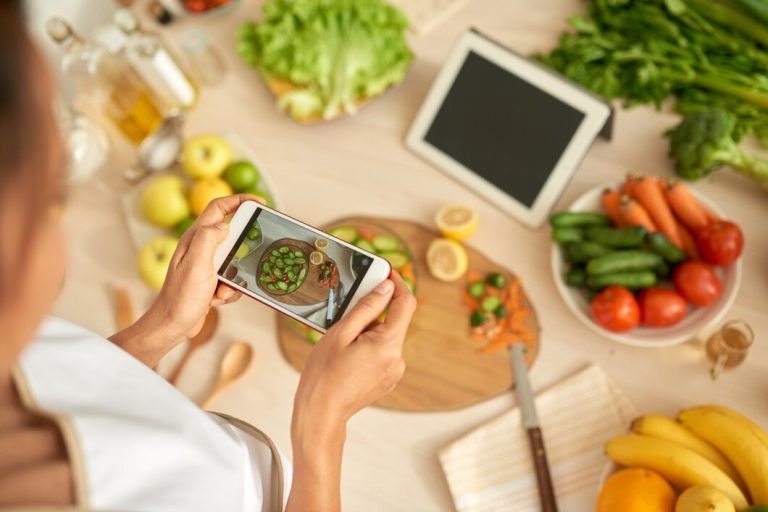
The single greatest barrier to effective dietary tracking—whether for weight loss, performance, or metabolic health—has always been the sheer tedium of food logging. Manually searching a database for the precise cut of steak or estimating the serving size of complex pasta has been the bane of every dieter. This barrier is finally falling thanks to a revolutionary application of Artificial Intelligence: computer vision nutrition. This technology enables AI food recognition to identify, measure, and analyze meals from a single photograph. This deep dive into food image AI explains how this technology works, its current accuracy, and why it is the definitive solution to the “user adherence” problem in personalized nutrition.
How Does AI Recognize Food from a Picture?
Computer vision is a field of AI that trains computers to interpret and understand the visual world. When applied to nutrition, it relies on complex models, often using deep learning food analysis, trained on massive, proprietary databases of labeled food images.
The Three-Step Recognition Process:
- Object Detection: The system first identifies all objects in the photo (e.g., “a plate,” “a fork,” “a piece of bread,” “an egg”).
- Semantic Segmentation: It then distinguishes between different types of food. Crucially, it isolates the boundaries between, say, the bread, the avocado, and the seeds on top.
- Quantity Estimation: Using reference objects (like a plate edge, a hand, or a coin placed next to the food) or specialized depth-sensing algorithms, the system estimates the volume and mass of each food item.
The final output is not just a guess—it’s a calculated measurement of each food type and its estimated volume, allowing for highly accurate automated food logging of calories and macros.
Accuracy of Computer Vision in Nutrition (OREO Framework)
O (Opinion): AI food recognition is rapidly achieving a level of accuracy that is often superior to the manual estimation methods used by human loggers.
R (Reason): This is true because human food logging is inherently prone to bias and estimation error. We consistently underestimate portion sizes, especially for high-calorie, palatable foods. A well-trained food image AI is immune to cognitive bias and relies on objective, repeatable mathematical models (like pixel density, volume metrics, and color saturation) to calculate quantity and composition, ensuring greater consistency and reliability in data capture.
E (Example): Imagine a dieter estimating a serving of mashed potatoes. A human is likely to estimate 1 cup when it’s actually 1.5 cups—a 50% error that throws off calorie targets significantly. A high-quality image recognition diet app model, however, can calculate the volume of the potato against the known diameter of the plate, flagging the portion size as significantly larger than average. Studies on the accuracy of computer vision nutrition in clinical settings have demonstrated that, while challenges remain for highly complex meals (like stews), its overall accuracy for single-item and mixed-plate meals often falls within a 10-15% margin of error—a significant improvement over the typical human logging error rate.
O (Opinion/Takeaway): Therefore, the future of automated food logging is inevitable; AI food recognition is the necessary step to making nutrition data capture passive, accurate, and scalable for personalized health.
The Future of Automated Food Logging
The ultimate goal of computer vision nutrition is to create truly passive tracking, where the user no longer has to actively open an app.
- Real-Time Feedback: Future systems will integrate with smart kitchen devices or even smart glasses, providing instant, spoken feedback: “Based on your genetics, this serving of white rice will spike your glucose—consider adding a spoonful of vinegar to lower the glycemic load.”
- Composition Analysis: The next evolution of deep learning food analysis will move beyond identification to composition. It will analyze the quality of a fried food based on the oil’s clarity or estimate the ripeness of a fruit based on color saturation, feeding this nuanced data back into the user’s personalized diet apps.
By eliminating the logging bottleneck, AI food recognition allows personalized diet apps to focus solely on their most important task: providing sophisticated, adaptive, and actionable health guidance.
About the Author